ResOpt
- Contact:
Dr. Sabyasachi Chattopadhyay, Dr. Elisabeth Eiche, Prof. Dr. Jochen Kolb
- Funding:
Funded by the BMWK (Project ID 03EI5454)
- Partner:
IBR - Institut für angewandte Bau- und Reststoff-Forschung (Dr.-Ing. Jürgen Reichelt); INTEC Engineering GmbH (Dr.-Ing. Markus Ricker)
- Startdate:
01.11.2022
- Enddate:
31.10.2025
What is the problem?
Biomass is an important renewable energy source, but its conversion to heat and electricity is not always straightforward. During combustion, inorganic components of biomass ash can melt, react and transform at high temperatures, leading to the formation of slag, deposits and other residues in combustion and boiler systems. These residues can reduce plant efficiency, disrupt operation and increase maintenance costs. Understanding when and why they form is therefore essential for the reliable and efficient use of biomass as a fuel.
What do we investigate?
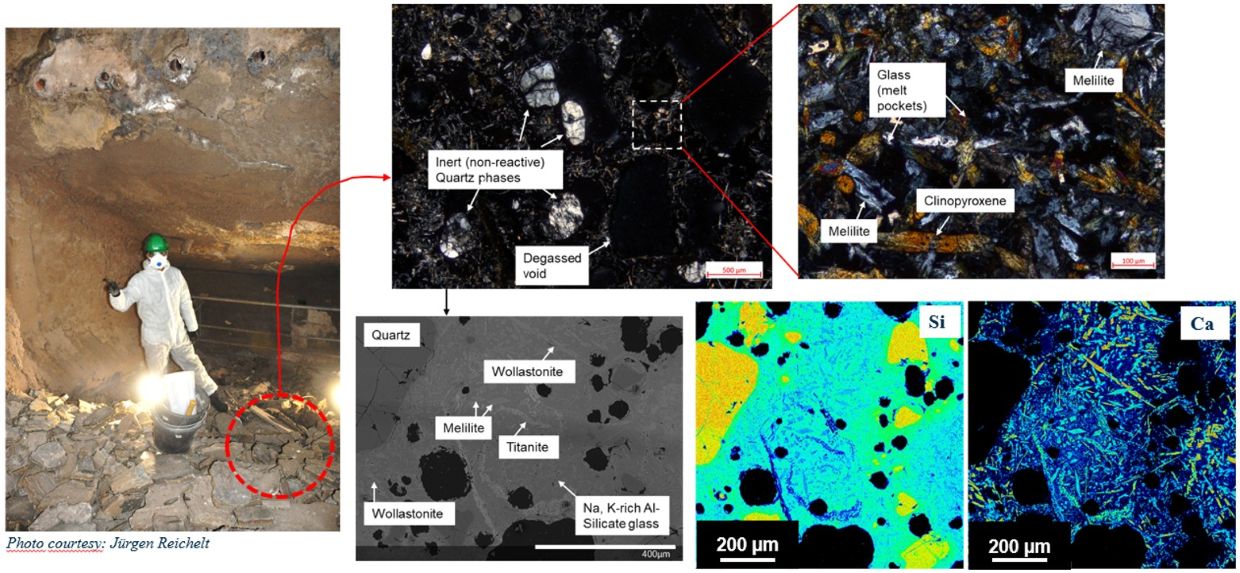
In ResOpt wewe investigate how biomass ash evolves during high-temperature combustion—from the original fuel ash to the residues formed in operating plants. We combine mineralogical and geochemical characterisation, high-temperature experiments and thermodynamic modelling to understand the processes controlling melting, crystallisation and residue formation.
We focus on the relationships between biomass composition, temperature, melt formation and the resulting mineralogy. By linking laboratory experiments with materials collected from operating plants, we aim to understand these processes under real combustion conditions. The project is carried out in collaboration with industry partners and BMCHP (Biomass Combined Heat and Power) plants, connecting fundamental scientific understanding with practical challenges in plant operation.
Why does it matter?
A better understanding of biomass residue formation can help predict where, when and under which conditions problematic slags and deposits develop. This knowledge can support improved combustion strategies, better fuel utilisation and more efficient plant operation. Ultimately, the goal is to reduce operational problems while maximising the useful energy obtained from biomass.
By combining geoscientific approaches with engineering perspectives and experience from operating plants, our research provides a process-based understanding of biomass fuel behaviour. This knowledge can help develop more reliable, efficient and sustainable biomass energy systems.